


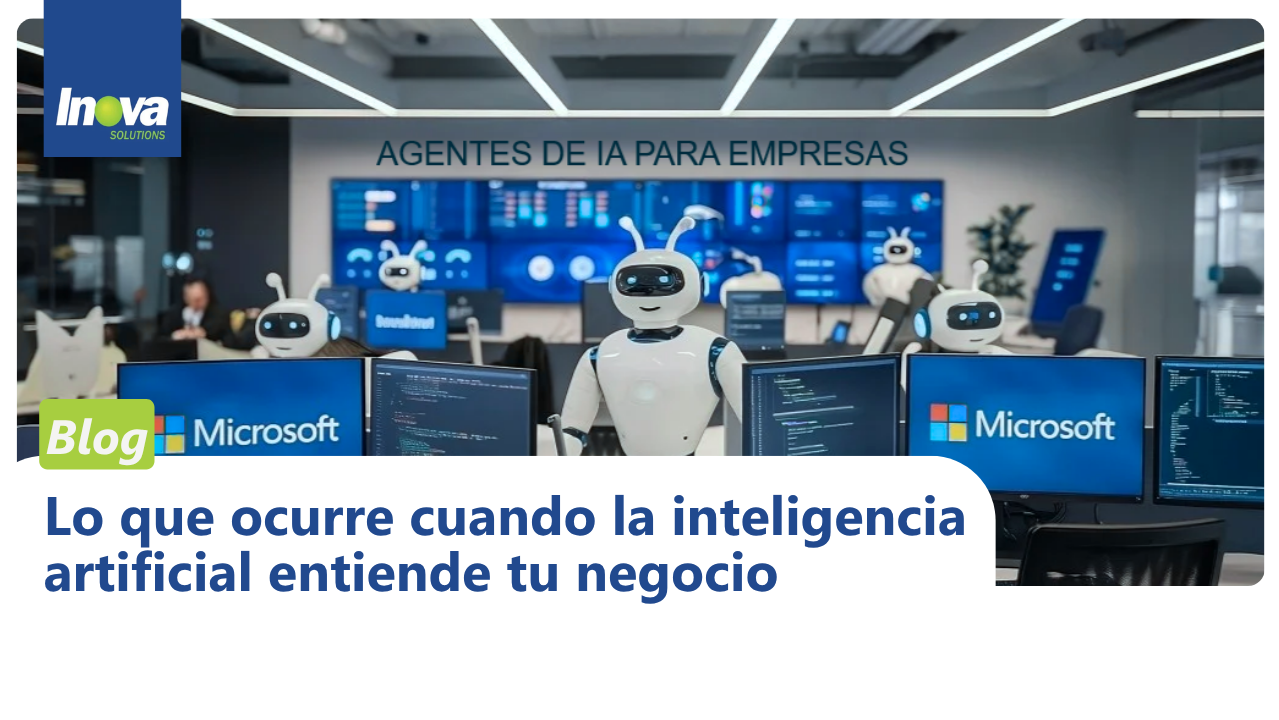
What would happen if the areas of Finance, Operations, sales or Human Talent could access the same information, recommendations and actions without relying on reports or consultations between computers?
Currently, thanks to the intelligent agents, this starts to become a reality for many companies.
The difference is important, because we don't talk anymore assistants that respond to specific questions, but of systems capable of understanding the context of each area, interact with different sources of information and collaborate in real processes.
Therefore, rather than adopting artificial intelligence, companies are starting to integrate it in their day-to-day.
Automate tasks to speed up decisions
For years, the technology is focused on making processes more efficient and fast. But with the passage of time, companies need to make better decisions in less time and with greater context.
That is where smart agents make the difference.
In addition to automating tasks, you can analyze information from different sources, identify patterns, generate recommendations, and perform actions within existing processes.
The result is an operation that is less fragmented and response capability is a lot more agile across the organization.
Why an AI for each area is not always the best answer
Each area has needs, metrics, and different goals.
Therefore, the value is not in implementing a unique artificial intelligence for the entire company, but have specialized agents able to understand the context of each function.
A financial agent can help you analyze variances to budget and projections. One business you can prioritize opportunities and follow up on customers. Meanwhile, areas such as Operations, Human Talent or Technology they can rely on agents designed to address specific challenges of your day-to-day.
However, the true potential appears when all are connected.
When the agents work together
A business opportunity may require financial information, validations and operational review of the contract. In the same way, a client request may involve support, billing, and tracking business.
That is why, one of the most important concepts is the orchestration of agents.
Instead of operating in isolation, different agents work together within the same workflow, providing information and actions from their specialty.
The result is more complete answers, processes more agile and more informed decisions.
The real challenge is not the AI
When talking about artificial intelligence, the conversation tends to focus on the technology.
However, one of the biggest obstacles remains the quality of the information.
Data scattered, disconnected systems, and knowledge stored in multiple formats limit the potential of any initiative of AI.
For that reason, the companies that get the best results typically start by building a solid base of information, where the data are reliable, they are connected and have clear rules of access and governance.
How to identify opportunities and implement intelligent agents
The majority of companies do not need dozens of officers from the first day.
The starting point is usually in those processes where repeating tasks, involving several areas or there is a high dependence of scattered information.
For example, processes such as attention to internal requests, the commercial follow-up, the search for corporate information, or the generation of reports tend to offer fast and visible results.
A good practice is to start with a use case specific, measure the impact and expand gradually the initiative to other areas of the organization.
In this way, the adoption ceases to be an experiment, and it becomes a strategy aligned with business objectives.
The AI begins to transform the operating model
When the agents are well integrated, the impact goes far beyond automation.
The equipment, reduce repetitive tasks, decisions will be accelerated and the knowledge no longer depends on specific people. This allows the areas to focus more on strategic activities and less on searching for information, consolidate data or to coordinate processes manually.
At that point, the artificial intelligence ceases to be an additional tool and begins to form part of the operation of the company.
What is your organization ready to take the next step?
Adopt intelligent agents does not only incorporate a new technology. The real challenge is in identifying the right processes, to connect information and to ensure that the solution generates real results for the business.
Therefore, a successful implementation requires a clear strategy, a reliable database and an accompaniment that allows to scale the initiative in an orderly manner.
At Inova Solutions we help organizations to make this journey from beginning to end. Since the identification of opportunities and the definition of use cases, up to the implementation, integration, and evolution of intelligent agents aligned to the needs of each company.
Because the value of artificial intelligence is not in the technology itself, but rather in its ability to generate impact in the operation, the decisions and the results of the business.